Building Trust Through Empathy and Clarity
Lessons from Jessica Anderen’s Journey of Actioning Empathy and Clarity at IKEA Foundation
- Blog
- All impact sectors
- All Regions
This article is drawn from an interview originally published on Acumen Founder and CEO Jacqueline Novogratz’s LinkedIn newsletter, “Moral Leadership.” Read the original interview here and subscribe to the newsletter here.
Jessica Anderen’s leadership is rooted in deep listening and excellence in execution. This was true during her decades running supply chains for IKEA in South Asia, Southeast Asia, Europe, and China, and it remains equally true in her position running one of the world’s largest foundations.
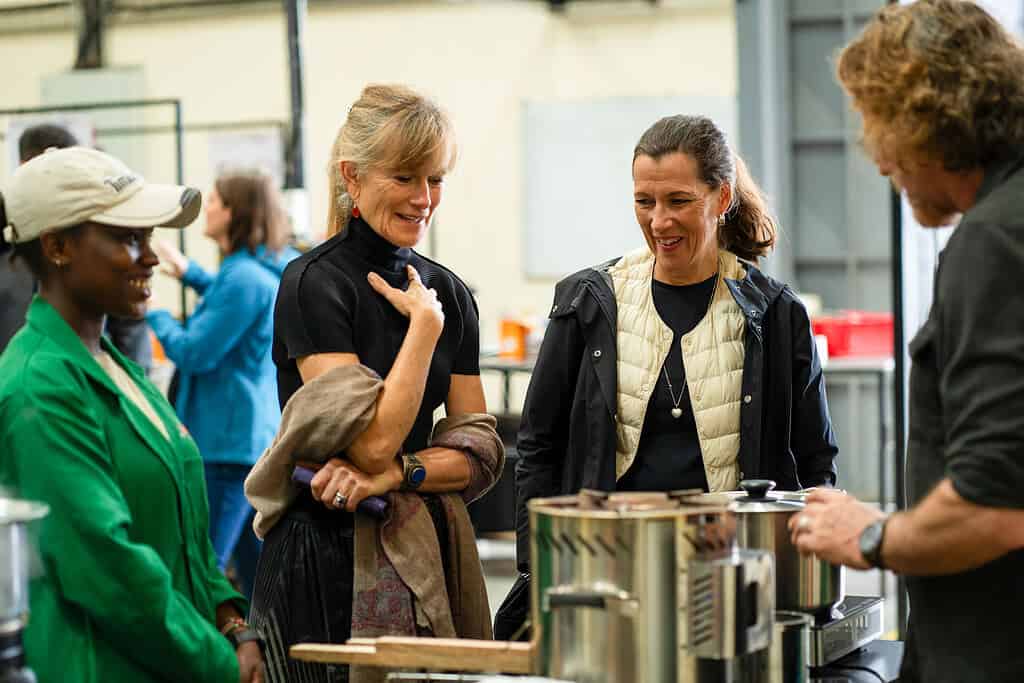
I’ve had the pleasure of doing deep-dive visits with Jessica, most notably on a rainy Sunday in Nairobi in 2024. What I noticed most was how much she loves people and is curious about who they are, how they make decisions, and how the work of the IKEA Foundation’s investees impacts their lives in real ways. Though our day included navigating muddy and sometimes flooded roads, as well as a less-than-perfect interaction with an entrepreneur, Jessica remained positive, excited to learn, and ready to contribute.
I learned a lot just by watching her leadership in action. She is honest, straightforward and empathetic. She’s helped build successful companies in challenging environments and knows just how much is possible to achieve with the right combination of head and heart.
You have long been an advocate for children in the world’s poorest regions. How did you come by that focus?
Prior to joining the IKEA Foundation as CEO, I spent over 30 years working throughout the value chain in the IKEA business, in Sweden, India, Pakistan, Bangladesh, China, Singapore, Australia and Switzerland.
My time in South Asia was particularly formative and still has a special place in my heart. I saw first-hand how tremendously difficult life can be for children and their families in the world’s poorest regions. When I think of my own upbringing and my children’s upbringing, we have been fortunate in ways you can’t even imagine until you’re confronted with deep levels of poverty.
During this time, I started collaborating with social entrepreneurs. I was working with WWF and the Better Cotton Initiative to help farmers drive more sustainable cotton farming. This initiative also looked at how to improve the lives of people living in poverty by supporting them into sustainable livelihoods through knowledge, education and connecting suppliers to purchase “Better Cotton.”
Now, as CEO of the IKEA Foundation, our mission is to improve the lives of vulnerable children by enabling their families to create sustainable livelihoods, and fight and cope with climate change. We chose this because we believe poverty and climate change represent two of the biggest threats to the futures of children around the world. Having the opportunity to work with our expert partners and co-create solutions with people who are closest to these challenges is a great privilege.
What values have guided you throughout your career?
My grandmother always told me: “follow your passion and your heart, work hard, be curious and believe in people.” As with the wider IKEA family, togetherness is a very important value for me. I believe that we are stronger together and perform better when we trust each other, pull in the same direction, learn from each other and, importantly, have fun together.
Leading by example is also key. I see leadership as an action, not a position. It requires listening to, understanding and giving agency to the people and communities that are closest to the problems. And it requires openness and transparency. Only by sharing learnings and fostering accountability can we co-create solutions to maximize impact and create a movement of positive change.
We ensure our values are embedded throughout the IKEA foundation by focusing on value-based recruitment and leadership. For me, it’s all about how we show up: our attitude, behavior and the respect we show each other. Putting values into action is crucial to nurturing and developing a strong spirit and culture.
Staying true to my beliefs and values is deeply tied to how to act, behave and show respect. I never compromise on my moral compass. I always start with trust. We can’t afford to spend years building trust when our goal is to accelerate impact. A lack of respect, kindness, or integrity truly upsets me.
Who has had a significant influence on the way you lead?
My reverse mentors. Reverse mentoring has greatly shaped how I lead. It bridges generational gaps and encourages the sharing of knowledge, which is vital for promoting diversity and inclusion. By breaking down stereotypes and fostering respect, it drives change and supports lifelong learning. It keeps me curious and aware of the world around me. As a leader in 2025, guiding a modern, values-based and connected philanthropy, this approach is essential for staying inclusive, relevant and connected.
What advice would you give to emerging leaders who want to put people and sustainability at the center of their organizations?
It’s not a task or check list. You have to believe and be truly passionate that being responsible is non-negotiable. We owe it to the next generation. We only have one home that we all share. In practice, you also need to measure value creation effectively and constantly. What social and environmental return on investment are you making for the organization?
More from our Knowledge Hub
From wealth to agency: How women can fund a more just future
Michelle Yue on expanding women’s agency and using philanthropic capital to transform entrenched gender inequities.