Who pays for dignity? Rethinking India’s waste economy
Entrepreneurs can’t fix a broken system alone. Fair pay and safe work require investors, government, and brands to share the cost.
- Blog
- Dignified jobs
- India
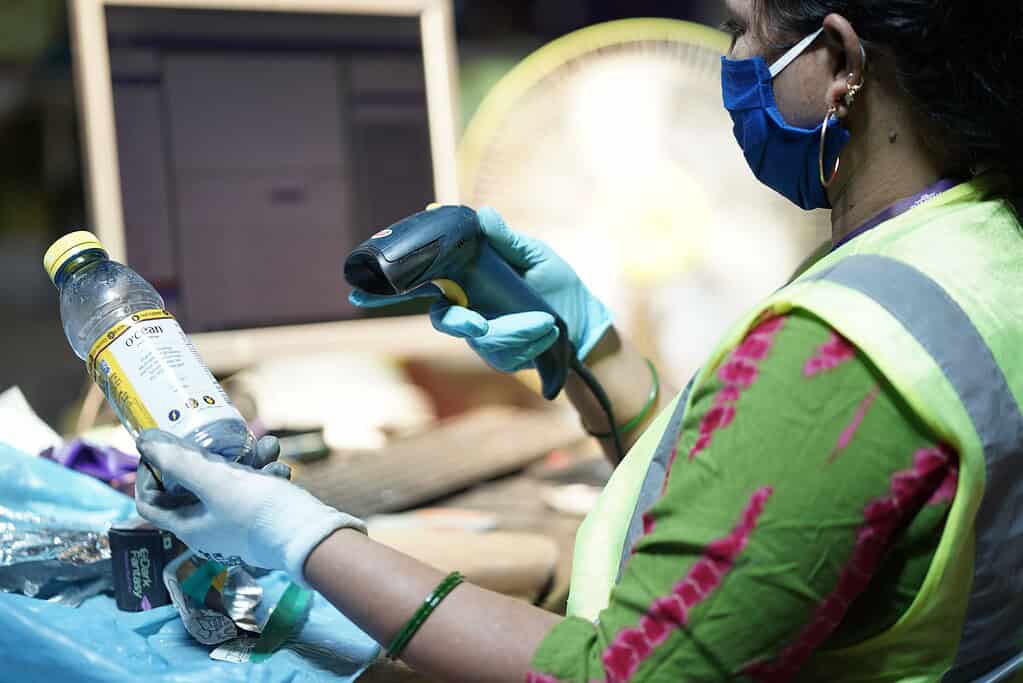
Despite the essential role that waste workers perform in any functioning city, they are often severely underpaid and denied the dignity, security, and recognition they deserve. This is especially true in India, where an estimated 4 million people work as Safai Saathis, or ragpickers, combing through hazardous landfills while facing extreme poverty and social alienation.
A new wave of startups is working to transform India’s waste management sector and the workers who power it. They’re doing so with a mix of innovative technology, community engagement, education, and business models that center worker dignity and safety. By providing Safai Saathis with fair pay, protections, and a path to stability, they’re helping people rise out of poverty while building the foundations of a truly circular economy. Acumen is proud to have invested in three of these companies — Green Worms, Bintix, and ReCircle — through our Green Growth Initiative.
Even as these enterprises gain traction, they remain fragile and are struggling to transform the larger system while surviving on razor-thin margins. That tension was at the center of a recent workshop that Acumen hosted with the Aspen Network of Development Entrepreneurs (ANDE). Together, we gathered entrepreneurs, investors, waste picker associations, and leaders across India’s waste sector to confront a crucial question:
What will it take to create and scale dignified jobs in waste value chains in India?
Entrepreneurs can’t absorb the cost alone
Participants reflected on recent progress across the sector and the structural constraints that continue to make dignity difficult to sustain at scale. One major theme emerged: Entrepreneurs are often left on their own to absorb the cost of paying workers fairly.
“It’s on us [entrepreneurs] to ensure that value transparently passes down to waste workers. But at the end of the day, it comes down to whether our unit economics work.”
Roshan Miranda, founder of Bintix
Competing in thin-margin markets, enterprises cannot absorb the full cost of dignity by themselves. And too often, they are not supported — or pushed — to do so. Jabir Karat, founder of Green Worms, highlighted the lack of prioritization from corporate brands and some investors. “It’s not the lack of intent,” he said. “Most recognize the importance of treating waste workers with dignity. But no one is actually prioritizing these things.”
He described inconsistent audits around how well his employees are treated or the safety and cleanliness of his facilities. Another entrepreneur raised a challenge to investors, “Are you just looking at profit? Or are you really pushing enterprises to fulfill this, even if it means sacrificing one to two percent margin?”
Is there wealth in waste – and for whom?
This led to a deeper reckoning with a widely held assumption: that waste is a profitable resource.
“We have to bust the myth that there is wealth in waste,” said Nalini Shekar representing the Alliance of Indian Wastepickers. “There’s money for people who put their hands in waste. Not for managers or big companies. Once we accept this, these interventions can work.”
Many echoed that waste will never function as a true profit center. In reality, responsible, end-to-end waste management is fundamentally a cost, not a profit engine — one that waste workers have historically paid for. In Karnataka for instance, there’s a viability gap funding of four to five rupees per kilo to manage these Materials Recovery Facilities.
Shekar Prabhakar of Hasiru Dala pointed to a deeper structural flaw. “It’s only because the waste picker collects and sorts waste that is tradeable, and the further chain of dealers and aggregators sort it into the fine categories that the recycler gets as homogenous input as possible. The value add of that chain of collecting, sorting and baling is what makes waste valuable and is not compensated adequately for that. Before that waste is waste. It has zero value.”
The result is a fundamental contradiction: Those who create the most value capture the least. Yet most investment still flows into recycling and processing rather than into collection and aggregation, where dignity is most at stake.
What it will take to scale dignified jobs
1. Government engagement
As the conversation turned to solutions, participants were candid about the importance of government and the challenges of engaging it. In most of India, households do not pay for the waste collection; instead they get paid for the scrap they sell. This fundamentally distorts incentives across the system and makes political engagement difficult.
“We’re always sitting on the fence about political engagement,” one participant confessed. “But it is critical at this point. Even what we’re saying about people expecting a free waste service is in some ways driven by what our political leaders promised.”
Others pointed to local government as underutilized system stabilizers. “There’s a lot we’re missing by not engaging more deeply with lower rungs of government, like ward officers, sanitary inspectors, and supervisors who see fewer transitions,” said Gauri Mirashi, co-founder of EcoSattva. “They can help build systems that work.”
Participants cited Bangalore and Kerala as examples of where local government engagement has enabled more functional waste systems. Across the board, they emphasized that meaningful change requires collective advocacy, moving beyond fragmented, short-term efforts toward long-term planning.
“Until enforcement changes, none of this will really change,” said Viraj Joshi, investor at RainMatter
2. Aligning corporate procurement and ground realities
In recycled plastics, prices are benchmarked to virgin plastic, ignoring the real costs of collection and pre-processing. Corporates demand high quality but rarely pay for what it takes to deliver it.
“The human angle behind waste is mostly ignored by brands”
Jabir Karat, founder of Green Worms
Creating transparency is essential. For instance, The Circulate Initiative, a global nonprofit, launched the Responsible Sourcing Initiative in 2023, a program focused on addressing human rights issues in recycling supply chains. Companies can use its Harmonized Responsible Sourcing Framework for Recycled Materials to improve their responsible sourcing practices, and implement human rights due diligence. The Responsible Sourcing Initiative currently has seven implementation projects in Asia and Africa, with plans to expand to Latin America in 2026.
The initiative has found traction with support from global brands and foundations but scaling implementation requires time, trust, and proof of a viable model. “Our implementation model is centered on engaging the full value chain to co-create remediation solutions that address root causes of human rights challenges. In time, we hope the learnings from these projects can be used to scale and advance responsible sourcing in more value chains and geographies.” said Arun Murugesh, Responsible Sourcing Initiative Director India at The Circulate Initiative.
3. Waste workers as central partners
Waste workers must be partners, not peripheral beneficiaries. Chinmayi Naik, executive director of Hasiru Dala shared the example of Bangalore’s Decentralized Waste Collection Centre (DWCC), where waste pickers operate the centers, conduct collections, and hold formal MOUs with the government.
“These models only work when there is viability gap funding and support from the government,” said Chinmayi.
As waste systems modernize, it is essential that waste workers are integrated. Whether through the Swachh Bharat Mission, NAMASTE scheme, or Solid Waste Management Rules, inclusion must be built in and backed by local implementation capacity and dedicated financing. Without this, modernization risks displacing livelihoods rather than dignifying them.
Looking Ahead
Despite the scale of the challenge, the leaders in the room remained committed to the future of dignified waste work. They agreed that dignity won’t emerge from innovation alone or policy in isolation.
Instead, it will require coordinated action across the ecosystem — investors, waste enterprises, worker collectives, and policymakers working in tandem. Most urgently, this means a shared commitment to advocacy from investors, corporates, and intermediaries to build collective muscle, align messaging, and engage government consistently with the right counterparts. In turn, governments need partners on the ground to translate policy into action.
It also requires sustained financing, particularly patient capital and viability gap funding, to enable long-term planning rather than short-term pilots. Most of all, it demands a willingness to continually confront who really bears the cost of dignity.
If you’re a waste leader interested in a potential future convening, please email nnadkarni@acumen.org.
To learn more, read Acumen’s recent report, What Waste Workers Want, which gathers insights from over 350 Safai Saathis in India.
More from our Knowledge Hub

From wealth to agency: How women can fund a more just future
Michelle Yue on expanding women’s agency and using philanthropic capital to transform entrenched gender inequities.