Infrastructure is destiny
TED2026 revealed the extremes of this moment and how we might navigate to a better world — if we move together.
- Blog
- All impact sectors
- All Regions
Early on the opening morning of TED2026, two drones lifted off and soared around the theater, seeking out the conference’s co-hosts through facial recognition. Later, a drone company CEO launched an autonomous drone in Tokyo live from the TED stage in Vancouver, while another drone CEO described a world where drones are omnipresent, humming across American cities as first responders, detectives, and friendly eyes in the sky.
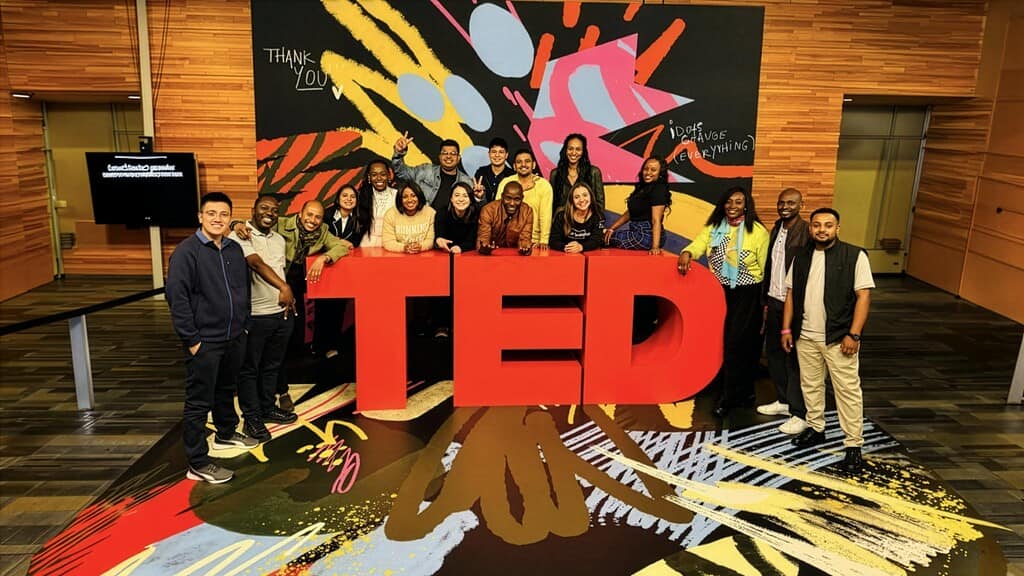
It was all a bit surreal. I was sitting with 15 Acumen Fellows, who are building enterprises that solve some of the toughest problems on the planet. They work in the margins with communities that are still contending with the basics like access to healthy food, steady electricity, and dignified work. We’ve brought a cohort of our Fellows to TED every year for five years now. It’s inspiring every time, but never has it felt as important as this year.
The theme for this year’s conference was “All of Us” — the idea that navigating this terrifying, hopeful moment will require everyone: drone manufacturers and Acumen Fellows, AI companies and Nobel laureates like Malala Yousafzai, who opened the conference with a reminder that for millions of girls, the right to simply go to school or play a sport remains unfinished business. One speaker cited a phrase drawn from an OpenAI white paper making the case for data center investment. Infrastructure is destiny. I kept turning it over all week.
Infrastructure is destiny.
Not roads and railways, although those matter. The invisible kind of infrastructure. The algorithms that channel our attention and spending online. The drones that circle the skies without us ever knowing. The platforms, protocols, and code written by corporations that now wield the power of empires. The systems that pre-determine the shape of what’s possible before any of us sit down to make a choice.
TED2026 arrived at a strange and urgent moment. Every breakthrough at the conference came with a shadow. Drones for safety — and for surveillance. A billion biological experiments in the next four years to map RNA the way LLMs cracked language — and the civil rights questions that trail quietly behind. Agents that can now do everything a person can do on a computer — and the obvious question that raises about human agency in an agentic future.
One of the most powerful talks came from Carissa Veliz, who asserted that predictions are not facts, even though our markets and therefore our world treat them as such. Facts belong to the past. And yet we are living through a moment when the most powerful tools are being used to make the future feel inevitable — to close the conversation before it begins. The story being told about AI, about displacement, about who will benefit and who will be left behind, is not yet written. It is a choice being made, right now.
When I walk into TED with Acumen Fellows, something shifts. Their presence is its own kind of moral compass. Their presence cannot help but make you think about who is not there, because their life’s work exists within the gap between the world being imagined and the world they are building in — that gap is exactly where the moral infrastructure either gets built or doesn’t.
Niharika Jain, the founder of Broomees in India, is building the infrastructure of dignified work for domestic workers, training, verifying, and professionalizing a workforce that has historically been invisible to the formal economy. When AI is being deployed to automate the so-called “menial,” Niharika is asking the prior question: How do we make this work visible? How do we make it count? Dignity, she understands, is not a feature you add later. It is the foundation.
Willie Ng, the founder of Global Cerah in Malaysia, is turning agricultural waste into animal feed and fertilizer, reducing input costs by 40%, building a circular economy from the margins for farmers who have been traditionally excluded. He left an eight-year corporate career because he saw what was being wasted, and what was possible. His work is infrastructure in the most literal sense: the kind that feeds people, restores land, and closes loops that extractive systems leave open.
Mainak Roy, the co-founder of Simple Education Foundation in India, has spent more than a decade building the infrastructure of learning for children in government schools, training teachers, transforming classrooms, working toward 10 million children across the country. His unyielding belief guides him: one good teacher can transform a life He understands that education is not a service, itis the infrastructure of agency itself.
These three — and the thousands of Acumen Fellows like them across our global community — are the human infrastructure. They are the steel and girders of a different kind of future. They have the expertise to understand the systems they are working within, the moral imagination to see beyond them, and the stubborn, grounded belief that the people most affected by broken systems are also the ones most capable of fixing them.
“Abundance without participation feels like scarcity,” Van Jones said. The infrastructure of opportunity — who gets access, who gets to build, whose knowledge is encoded and whose is ignored — does not assemble itself. It is built, or it isn’t, through deliberate choices made by people with the vision and the will to make them.
The razor’s edge between hope and fear is real. I felt it at TED2026 more acutely than any year before. But I also felt something else: the quiet, resolute presence of builders who have looked at the world as it is and chosen to build the world as it could be. A growing force that is not succumbing to the power of prediction or presumed “inevitability” of how the world will shake out, but rather actively shaping it through grit, will power and community, and a belief that we will be okay, if we ground in our shared humanity.
More from our Knowledge Hub
Beyond the lamp count
Could PULSE, a new Paris-aligned carbon credit methodology, unlock additional revenue for off-grid solar enterprises?