No school, no football: How one rule changed 40,000 lives in India
Acumen Fellow Ashok Rathod shares the story of the OSCAR Foundation, which uses football to build resilience, leadership, and opportunity for children across India.
- Blog
- All impact sectors
- India

When Ashok Rathod was a boy, he called football “a monsoon game.” Whenever the rainy season came, he and his friends forgot about cricket and played football instead. They lived in Ambedkar Nagar, a poor neighborhood in Mumbai where space was cramped and athletic fields nonexistent. So they played in the street with a plastic bottle or the rubber bladder of an old basketball.
As Ashok grew, he stuck with football and school and eventually enrolled at university. His friends, meanwhile, got stuck in gangs or addicted to drugs and watched their professional prospects dwindle to working in the local fishmarket, as Ashok’s own parents had done. A light bulb went on: If Ashok could inspire children to embrace football, perhaps he could inspire them to stay in school, build resilience and leadership skills, and prepare them for the future.
Fast forward 18 years and the OSCAR Foundation has transformed the lives of more than 40,000 children through football. They’ve opened digital learning centers across Mumbai, created championship calibre boys’ and girls’ teams, and won the support of FIFA and some of the biggest football clubs in the world. In the buildup to the World Cup, we sat down with Ashok to discuss his journey and what makes football such a powerful agent of change.
What was your experience like with the very first group of children at the OSCAR Foundation?
I identified 18 boys in my community. Twelve had already dropped out of school, and six were borderline. I asked them, “Would you like to play football?” They said, “No, we want to play cricket.” I didn’t have money to buy a cricket bat, so I convinced them to come to the park on Saturday and learn football. I didn’t expect any of them to show up, so I didn’t buy a football, but they all came and said, “How are you going to teach us football without a football?” So I borrowed 400 rupees from my father and with that, I bought our first football. The boys came back the next Saturday. I thought I would get them to play and then share my story, my friends’ stories, and they would understand and go back to school and that would be it. That one day turned into a lifetime.
What did those early sessions reveal about why football is a powerful way to make positive change?
I was shocked. I thought these children would love playing football with each other. But quickly I discovered that they broke into groups and wouldn’t share the ball. I asked them, “Why don’t you pass the ball over there?” One group said, “Because they are Muslim, we don’t want to play with them.” The Muslim children said, “They are Hindu, I don’t want to play with them.” The third group was Bihari, a form of Hindu from North India. They said, “We don’t want to play with these local boys because they’re teasing us.” So I identified the leaders of each group and whenever there was a match, I always put those three players on the same team. And I made a simple rule: If they score, they have to celebrate. If they don’t celebrate, their goal will not count. And when they were celebrating, slowly, slowly they forgot their caste, their religion, and they became one team. That’s when I added another simple rule: No school, no football.
Football is a sport that naturally teaches life skills like teamwork, resilience, and leadership. How do you structure your program to reinforce these skills?
Each of our practices includes 20 to 30 minutes working on technique. That’s when we teach life skills. For example, many of our children face peer pressure. So we organize a small-sided game where there are two offensive players and three on defense. It’s challenging to score. So then we bring them together and ask why they weren’t scoring. They say, “Because we were less, and they were more.” So that means they’re putting more pressure on you, right? When you go back in the community, what kind of pressure do you face? We do similar lessons with addiction, child marriage, all the different challenges that our children face. We ask one team to score only with their heads and one team to play normal football. The team that can only score with their heads, they get frustrated and say, “Of course they will win because they have more options.” So then we talk about things that create more options in their lives, and they realize that if we study well, we will have more options to succeed. Football itself is a classroom.
What resistance did you face building the girls’ program, and how did overcoming that resistance change the community?
It took me six years to make one girls’ football team. The parents refused. They said, “What are you talking about? Why do girls need to learn football? They only need to learn household work because after the marriage, they will take care of the husband and family.” One day I got a call from a football academy hosting a girls’ football tournament. I don’t know what came into my mind. I said, “Yes, I have a girls’ team.” Of course I didn’t, but I figured in a week I could put one together. It was 11 o’clock when I received that call. They said, “Okay, bring your team at two o’clock today, you have a match!” Next to my house there was a girl washing plates. I said, “Sunita, you want to come for a picnic?” She said, “Yes, I would love to!” She got some of her friends, and I got permission from their parents to go on a picnic.
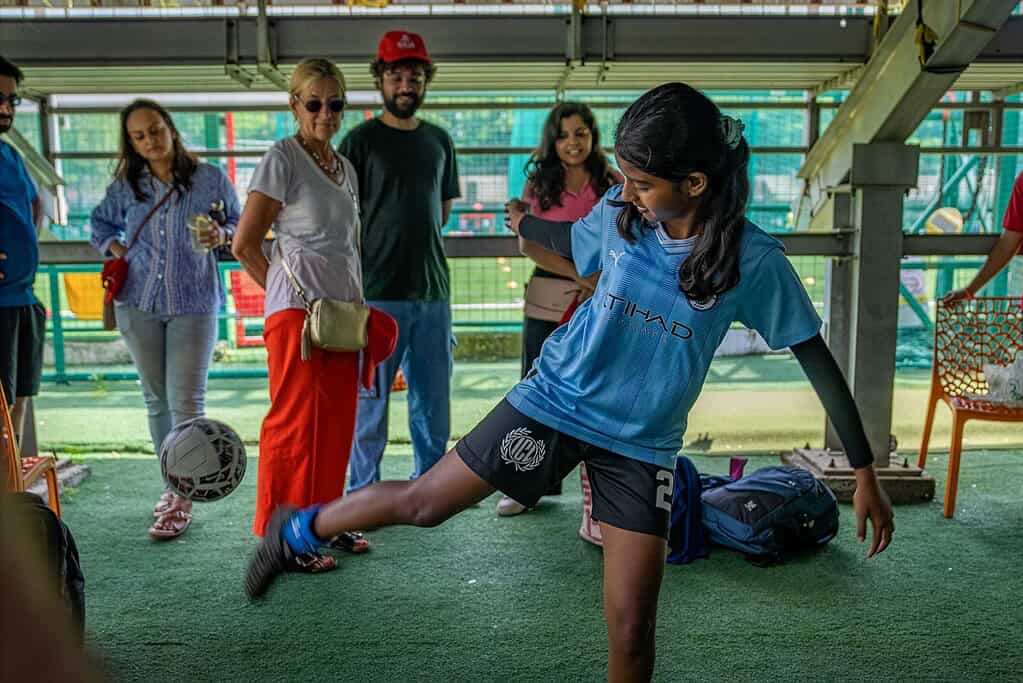
When we got to the field, they said, “Where’s the picnic?” I told them, “We’re playing football!” They said, “We have never seen a football. You never taught us, and you are asking us to play football with the other team?” But they went out there, and they stood in front of the goal like a wall, every one of them. That game went to penalties. They lost, but they got the confidence and a uniform and they were very happy. Eight years later, our girls team went to Denmark and won the world’s second-largest youth tournament. The entire community was playing drums and celebrating their achievement. Politicians, the police, everyone came. That’s how the mindset has changed. The parents no longer stop the girls from playing. Forty-two percent of the children in our program are now girls, and all of them are in school.
You became an Acumen Fellow in 2021 and Acumen Angel in 2024. How did that shape you as a leader, and where is the OSCAR Foundation headed now?
During the Pandemic, we were doing everything we could to support the community. It was very difficult. The police stood outside and blocked our community in. No one could come out. There was no social distancing. Everyone was asking to wash hands regularly, but we got only limited water. So it was a very bad situation, and I was looking for some way to think more broadly and develop myself more as a leader, and meet other people and learn how they were creating more impact at scale. So Acumen came into my life at the right time. I learned so much from my cohort and began to see a broader picture. I got clarity. I was able to reflect on myself and what I wanted to accomplish. My mind became fresh again. After the Fellowship and with the help of the Angels award, I scaled to three more states and was able to come up with a customized in-school program. So now we can train teachers and community leaders to replicate this model across India. Our goal is to reach half a million children in the next four years. We want children in school to be more physically active and for teachers to realize that this is real education.
Just like Ashok changed the game for thousands of children in India, we’re trying to change the game for entrepreneurs who are helping low-income communities adapt to climate change. Support our campaign! Love the World Game. Love the World More.
More from our Knowledge Hub
Beyond the lamp count
Could PULSE, a new Paris-aligned carbon credit methodology, unlock additional revenue for off-grid solar enterprises?